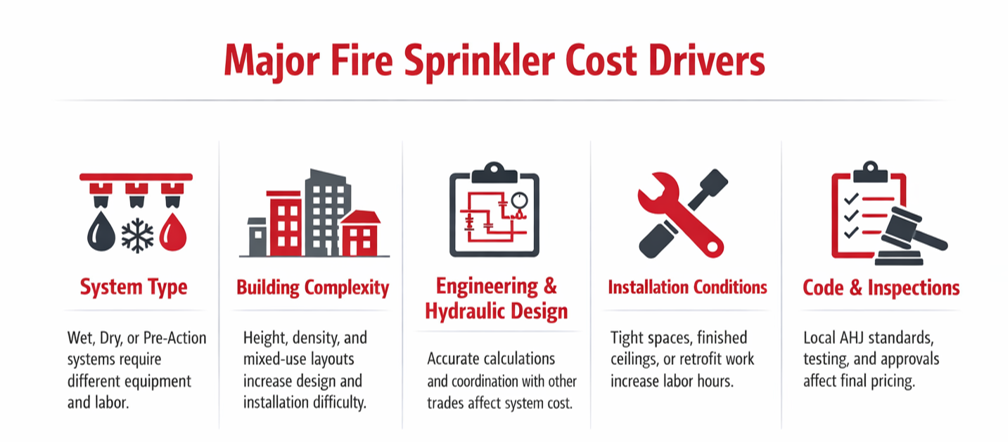
In multifamily construction, fire sprinkler budgets are often treated as a commodity line item. This assumption often leads project teams to underestimate how strongly system classification, water supply conditions, and vertical coordination influence both cost and schedule. Multifamily fire sprinkler cost variability is driven less by pipe and fittings and more by system classification, hydraulic demand, vertical distribution, and coordination risk.
For mid-rise and podium projects, early decisions around system type, height interpretation, and water supply assumptions frequently determine whether a project proceeds smoothly or enters redesign during permit review.
Understanding true multifamily sprinkler system cost factors reduces schedule exposure and improves first-pass approval probability.
System Classification Is the Primary Cost Driver
The distinction between NFPA 13 and NFPA 13R is frequently the single largest technical driver in multifamily fire sprinkler cost.
When a project shifts from NFPA 13R to NFPA 13, impacts may include:
- Increased hydraulic density requirements
- Expanded concealed space protection
- Standpipe integration
- Fire pump evaluation
- Larger riser configurations
Material cost increases are measurable, but coordination and redesign impacts often exceed direct equipment changes. In many apartment and mid-rise projects, the NFPA 13 vs 13R cost difference is less about pipe quantity and more about infrastructure scope and vertical integration.
Height Interpretation and Podium Conditions
Eligibility for NFPA 13R frequently hinges on building height interpretation.
Key considerations may include:
- Measurement to the highest occupied floor versus overall roof height
- Podium separation treatment
- Parking garage configuration
- Local amendments modifying baseline thresholds
Projects that assume qualification without confirming measurement methodology risk late-stage reclassification.
Height verification during schematic design protects both schedule and budget.
Water Supply and Hydraulic Demand
Water supply conditions materially affect cost drivers in multifamily construction.
Higher hydraulic demand may require:
- Fire pump installation
- Upsized underground mains
- Larger backflow preventers
- Enhanced coordination with civil design
Assuming adequate static and residual pressure without early testing can introduce pump requirements during design development, compressing schedule and increasing change exposure. For example, a mid-rise multifamily project may be priced assuming adequate municipal pressure for a standard NFPA 13R system. When flow testing later reveals insufficient residual pressure, the design may require a fire pump and revised hydraulic calculations. This change introduces equipment coordination, electrical service planning, and additional permit review cycles.
Standpipe Requirements in Mid-Rise Projects
Standpipes frequently separate moderate-scope systems from complex vertical infrastructure.
When required, standpipes affect:
- Shaft sizing
- Riser room allocation
- Pump coordination
- Inspection sequencing
Failure to allocate adequate vertical space early can force architectural revision during permit review.
Standpipe integration is a coordination driver as much as a material driver.
Concealed Spaces and Amenity Areas
Multifamily projects often include:
- Attic spaces
- Amenity decks
- Clubhouses
- Fitness areas
- Retail podium transitions
Concealed space interpretation and occupancy classification of amenity areas can shift system density requirements and sprinkler system cost per square foot.
These scope decisions influence both hydraulic modeling and layout complexity.
Labor and Installation Efficiency
Material pricing fluctuates, but installation efficiency is often the most meaningful cost variable in multifamily sprinkler systems.
Cost drivers related to labor may include:
- Ceiling heights and access conditions
- Framing coordination timing
- Trade stacking
- Prefabrication strategy
- Schedule compression
Design decisions that improve field access and coordination reduce downstream labor variability and stabilize overall apartment sprinkler system cost factors.
Multi-State Code Variability
NFPA standards provide national guidance, but adoption and amendment vary by jurisdiction. State-specific fire code adoption details vary, so it is important to verify local requirements early in the design process.
Across our multi-state footprint, local interpretation may influence:
- Height measurement methodology
- Standpipe triggers
- Seismic bracing requirements
- Water supply documentation
Early coordination with the Authority Having Jurisdiction reduces review cycles and protects schedule integrity.
Coordination Between Design and Architecture
Multifamily sprinkler cost drivers are often coordination drivers.
Alignment between fire protection design, architectural layout, and MEP systems affects:
- Riser placement
- Shaft dimensions
- Pump room allocation
- Access panels
Early collaboration improves predictability and increases first-pass approval probability.
Learn more about our multifamily fire protection expertise, commercial fire protection services, and our NFPA 13 vs 13R vs 13D comparison.
Multifamily Sprinkler Cost Driver Matrix
| Cost Driver | Budget Impact | Schedule Impact | Coordination Risk |
|---|---|---|---|
| NFPA 13 vs 13R Classification | High | High | High |
| Fire Pump Requirement | Moderate to High | High | High |
| Standpipe Integration | Moderate | High | High |
| Height Interpretation | Variable | High | High |
| Concealed Space Scope | Moderate | Moderate | Moderate |
| Labor Efficiency & Trade Stacking | Moderate | High | Moderate |
Cost Escalation Scenario Example
Scenario: A five-story podium multifamily project is initially assumed to qualify for NFPA 13R. During plan review, height interpretation triggers NFPA 13 compliance. Standpipe integration and pump evaluation are introduced. Hydraulic calculations are revised. Architectural coordination is reopened.
The resulting redesign cycle compresses schedule and increases coordination complexity. In this scenario, the most significant cost driver is not material quantity but reclassification and infrastructure adjustment.
Why Early Preconstruction Engagement Reduces Cost Risk
The most consistent way to control multifamily fire sprinkler cost drivers is early design alignment before drawings are locked. Understanding the full project lifecycle helps teams identify the right engagement points.
Early involvement enables:
- Accurate system classification
- Verified water supply data
- Proper vertical space allocation
- Realistic budget alignment
Multifamily sprinkler cost variability is rarely material driven. It is classification and coordination driven. Early preconstruction review materially improves predictability across multi-jurisdiction projects.
Frequently Asked Questions
What is the largest cost driver in multifamily sprinkler systems?
System classification (NFPA 13 vs NFPA 13R) is typically the most significant driver. Reclassification during permit review can trigger density changes, standpipe integration, and hydraulic redesign.
Do fire pumps significantly increase multifamily sprinkler costs?
Fire pumps increase equipment and coordination requirements. However, schedule compression and redesign impacts associated with late pump introduction often exceed direct equipment cost.
Does building height affect sprinkler cost?
Yes. Height interpretation may determine eligibility for NFPA 13R versus NFPA 13 and can influence standpipe requirements, hydraulic demand, and vertical infrastructure scope.
Are sprinkler costs primarily material-driven?
No. While material pricing matters, system classification, hydraulic demand, coordination complexity, and installation efficiency frequently drive total cost variability.
Conclusion
Fire sprinkler cost drivers in multifamily construction extend beyond material pricing. System classification, height interpretation, hydraulic demand, standpipe requirements, and coordination discipline materially influence both budget and schedule.
Early preconstruction engagement reduces redesign risk by confirming system classification, verifying water supply conditions, and coordinating vertical infrastructure before drawings are finalized.
Engage our design team early to align system selection and hydraulic modeling with your project's budget and schedule objectives.