Fire sprinkler plan review is one of the most critical—and often misunderstood—steps in any commercial construction project.
Delays in permitting, rejected plans, and last-minute redesigns don't usually happen because of poor intent. They happen because teams don't fully understand how the review process works with the Authority Having Jurisdiction (AHJ).
For general contractors, this process directly impacts:
- project timelines
- coordination with other trades
- inspection readiness
- final certificate of occupancy
This guide breaks down how fire sprinkler plan review works—and where projects typically go wrong.
Related reading: NFPA sprinkler system standards, fire sprinkler cost drivers, and types of fire sprinkler systems.
How the Fire Sprinkler Plan Review Process Works
At a high level, every fire sprinkler system moves through five phases from design to final approval.
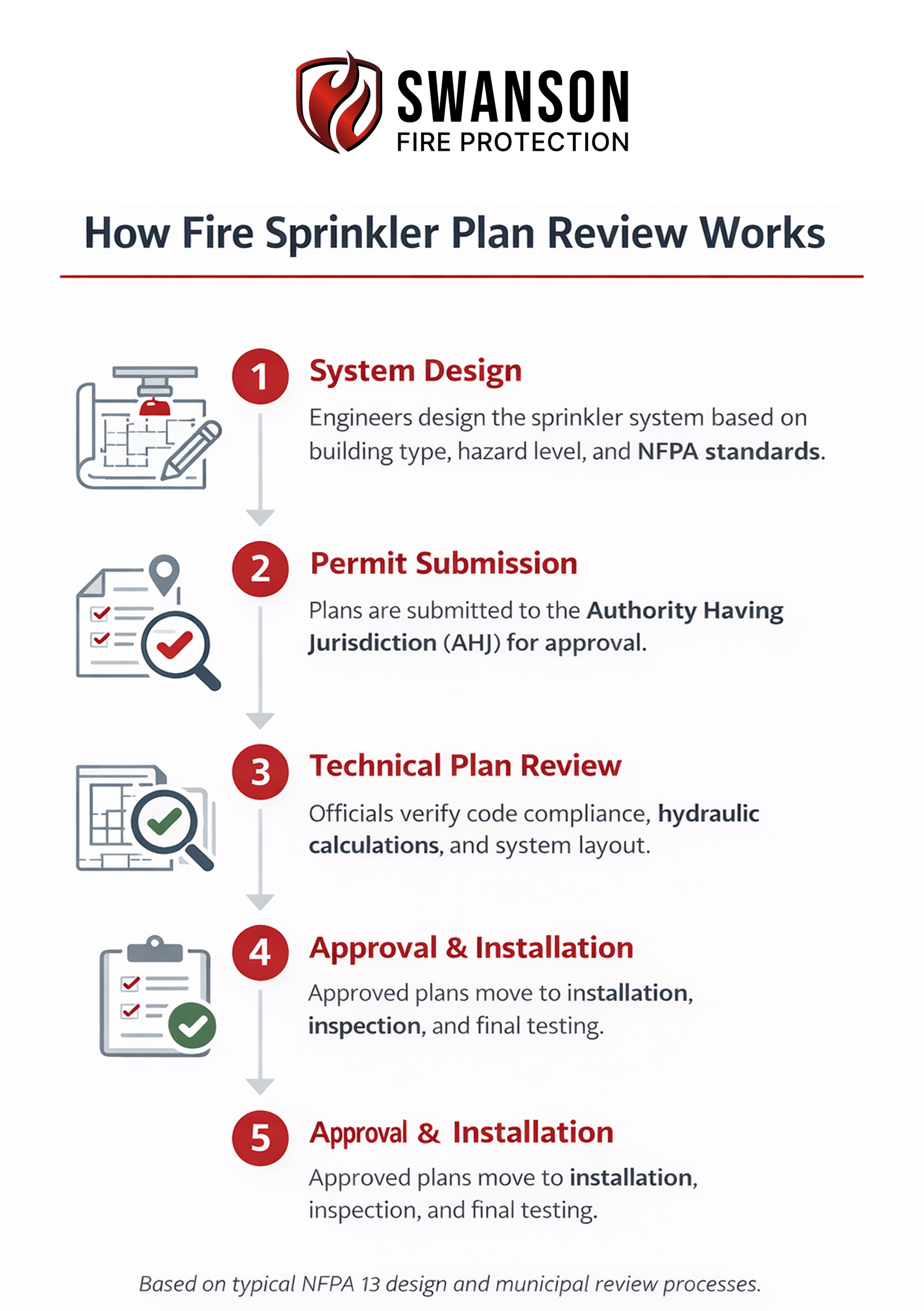
1. System Design
The process begins with engineering and design.
Fire sprinkler systems are designed based on:
- building type
- occupancy classification
- hazard level
- applicable NFPA standard
Design includes:
- layout drawings
- pipe sizing
- sprinkler head selection
- hydraulic calculations
In multifamily construction, misclassifying areas like parking garages or storage spaces can significantly change system density and cost.
Critical point:
If the hazard classification or density requirements are incorrect at this stage, the entire system will require redesign later.
2. Permit Submission to AHJ
Once design is complete, plans are submitted to the Authority Having Jurisdiction (AHJ).
Submittals typically include:
- stamped drawings
- hydraulic calculations
- product data sheets
- equipment specifications
The AHJ may be:
- local fire marshal
- building department
- third-party reviewer
Common issue:
Incomplete or poorly organized submissions are one of the biggest causes of delays.
3. Technical Plan Review
The AHJ performs a detailed technical review to verify:
- compliance with NFPA standards
- accuracy of hydraulic calculations
- proper system layout
- coordination with building design
Each AHJ may interpret code slightly differently, which is why local experience matters.
This is where most projects encounter friction.
Typical review comments include:
- incorrect density or design area
- missing or incomplete hydraulic data
- conflicts with architectural or structural elements
- improper coverage in concealed spaces
Reality:
Most delays occur in this phase—not during installation.
4. Approval and Installation
Once plans are approved, the project moves into installation.
This includes:
- material procurement
- system installation
- coordination with other trades
- field adjustments
Major risk point:
If field conditions differ from approved plans and changes are not documented properly, it can lead to:
- failed inspections
- rework
- additional costs
5. Inspection and Final Testing
After installation, the system must pass inspection and testing.
This includes:
- rough inspections
- hydrostatic testing
- final acceptance testing
The AHJ verifies that:
- installation matches approved plans
- system performs as designed
- all code requirements are met
This is a pass/fail stage—there is no flexibility.
Why Fire Sprinkler Design Often Starts Under Pressure
In many construction projects, fire sprinkler systems are one of the last trades to be contracted.
By the time a sprinkler contractor is brought in:
- the project is already moving
- other trades are underway
- deadlines are tight
- design is expected immediately
From the general contractor's perspective, this creates urgency: "We need drawings now so the project can stay on schedule."
From the sprinkler contractor's perspective, this creates risk. Fire sprinkler systems are not plug-and-play. They require:
- accurate building information
- coordination with structural, mechanical, and electrical trades
- verified water supply conditions
- proper hazard classification
When design is rushed without full coordination, it often leads to:
- redesigns after submission
- conflicts in the field
- rejected plans during AHJ review
- delays that are more costly than doing it right the first time
The issue isn't speed—it's starting design without full project alignment.
The Trade-Off Between Speed and Accuracy
Speed matters on every project—but in fire protection, speed without coordination creates downstream problems.
The most efficient projects aren't the ones that start design the fastest. They're the ones that:
- align early
- coordinate properly
- submit complete and accurate plans
That approach reduces:
- AHJ comments
- change orders
- installation conflicts
- inspection failures
Rushed design doesn't save time—it shifts delays downstream where they are more expensive.
Where Fire Sprinkler Projects Break Down
Most failures follow a predictable pattern. Most sprinkler issues don't come from installation; they come from poor coordination earlier in the process.
Common breakdown points include:
- incomplete or rushed design packages
- lack of early coordination with other trades
- unclear communication with the AHJ
- design changes not reflected in updated plans
- assumptions about code requirements instead of verification
These issues create:
- delays
- change orders
- strained GC relationships
How to Avoid Delays in Plan Review
General contractors can reduce risk by focusing on a few key areas:
Early Coordination
Align sprinkler design with:
- structural layout
- ceiling systems
- mechanical and electrical trades
Complete Submittals
Ensure all required documents are included and properly organized.
Clear Communication with AHJ
Understand local expectations early—not after submission.
Field Alignment
Make sure installation matches approved drawings—or submit revisions before proceeding. The goal is not faster design, it's fewer revisions.
How Swanson Fire Protection Supports the Process
At Swanson Fire Protection, we focus on getting the process right from the start.
That means:
- accurate, code-compliant system design
- complete and organized plan submissions
- early coordination with project teams
- alignment between design, installation, and inspection
Our team includes experienced, NICET-certified designers who understand both code requirements and real-world construction dynamics.
The result is fewer surprises—and projects that move forward without unnecessary delays.
Frequently Asked Questions
What is the AHJ in fire sprinkler systems?
The Authority Having Jurisdiction (AHJ) is the organization responsible for approving fire protection systems. This is typically a local fire marshal or building department.
How long does fire sprinkler plan review take?
It varies by jurisdiction, but plan review can take anywhere from a few weeks to several months depending on complexity and submission quality.
What causes sprinkler plans to be rejected?
Common reasons include incomplete documentation, incorrect hydraulic calculations, and failure to meet NFPA code requirements.
Do all fire sprinkler systems require plan review?
Yes. Nearly all commercial fire sprinkler systems must be reviewed and approved before installation begins.
When should fire sprinkler design start in a construction project?
Fire sprinkler design should begin as early as possible during preconstruction, ideally alongside architectural and MEP coordination, to avoid downstream delays and redesigns.
Start Your Project with a Clear Plan
Fire sprinkler plan review doesn't have to slow your project down. With the right design, coordination, and documentation, you can avoid delays and move through approval efficiently.
Swanson Fire Protection works with general contractors and developers to ensure systems are designed, submitted, and installed correctly from day one.
Contact us to discuss your upcoming project.
About Swanson Fire Protection
Swanson Fire Protection designs and installs fire sprinkler systems for commercial and multifamily construction projects across the Southeast and Mid-Atlantic. Our team focuses on delivering code-compliant systems that move efficiently from design through final inspection—helping general contractors stay on schedule and avoid costly rework.
About the Author
Jacob Terherst is Vice President of Preconstruction at Swanson Fire Protection and a NICET Level III Fire Sprinkler Designer. He specializes in system design, hydraulic calculations, and code compliance across multifamily and commercial construction projects.