
Fire pumps don't show up early in projects. They show up late—and when they do, they create problems.
- Unplanned cost
- Redesigns
- Trade conflicts
- AHJ delays
Most of it is avoidable. This guide gives you a clear answer to:
- When a fire pump is required
- Why it's needed
- How it impacts your scope and schedule
- Where responsibility shifts between trades
What Is a Fire Pump?
A fire pump is a pressure-boosting system that ensures your sprinkler system can deliver the required flow and pressure. It does not create water. It amplifies the available supply.
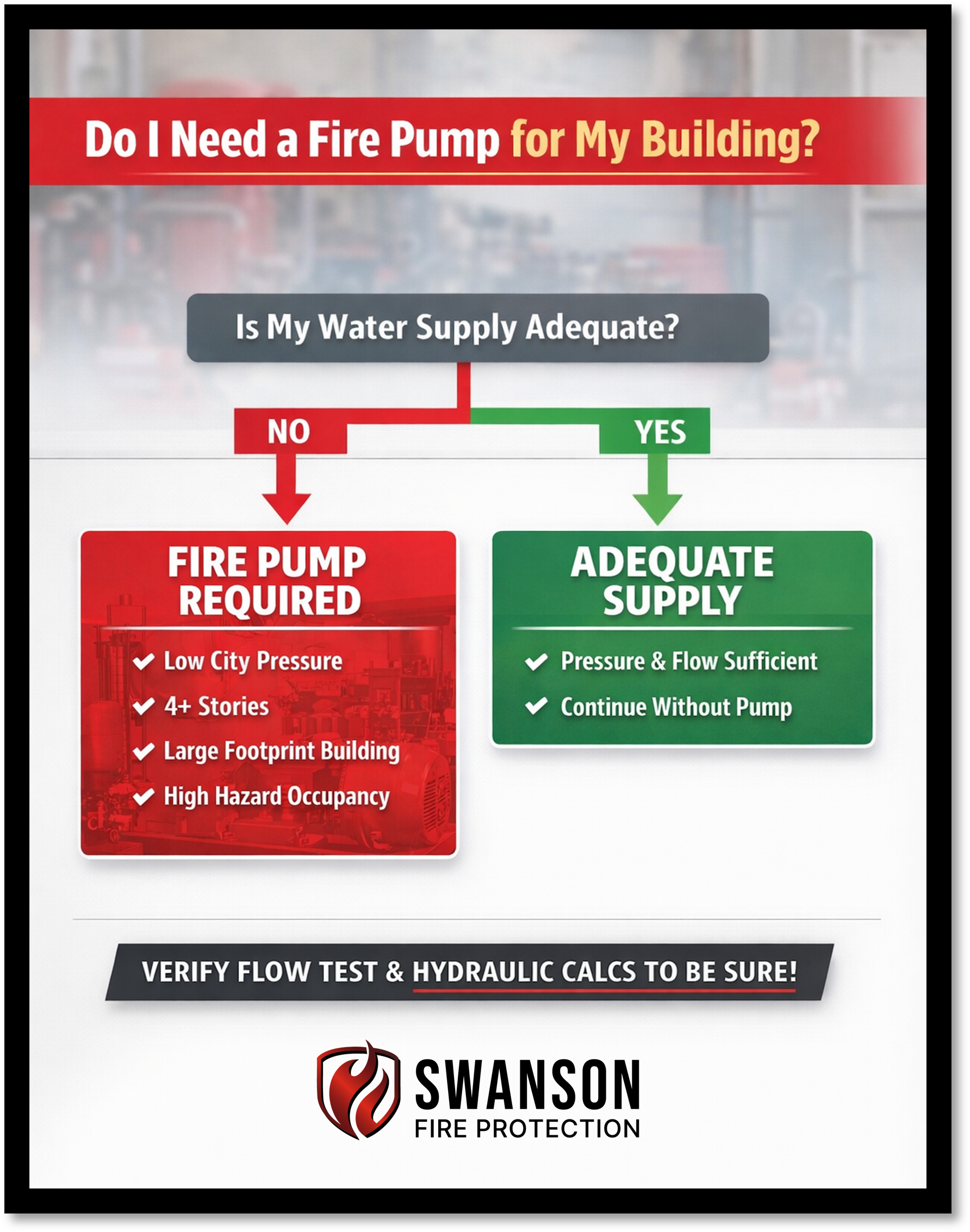
Quick Decision Guide: Will My Project Need a Fire Pump?
If any of the following are true, assume a fire pump is likely required:
- Building is 4+ stories
- Static water pressure is below ~50–60 psi (varies by design)
- Large footprint building (long pipe runs = friction loss)
- High hazard occupancy
- AHJ has required pumps on similar nearby projects
Bottom line:
If you don't have a verified flow test and hydraulic calculations—you don't know.
When Is a Fire Pump Required?
A fire pump is required when the available water supply cannot meet system demand.
That determination is based on:
- Flow test data
- Hydraulic calculations
- Code requirements (NFPA 13)
- AHJ interpretation
Common Triggers
- Low municipal pressure
- Building height (pressure loss vertically)
- High system demand (density/area)
- Friction loss (large buildings, long runs)
What Does a Fire Pump Actually Do?
It ensures:
- Water reaches the most remote sprinkler head
- Required pressure and flow are maintained
- System performs under worst-case conditions
Without it:
- The system may be installed
- But it won't meet code or perform when needed
What You Actually Need to Know About Fire Pumps (As a GC)
You typically won't choose the pump type. That decision is driven by:
- Available power
- Site conditions
- Code and AHJ requirements
What matters to you is:
- Space → dedicated pump room
- Power → major coordination item
- Scope clarity → who owns what
- Schedule impact → when it hits your job
Bottom line: You don't need to understand the pump—you need to understand the impact.
Where Plumbing Ends and Fire Protection Begins
This is one of the most common sources of conflict on real jobs.
Typical Scope Split
| Scope | Responsible Trade |
|---|---|
| Water service to building | Plumbing |
| Backflow preventer | Plumbing or Fire (varies) |
| Fire pump system | Fire Protection |
| Sprinkler system downstream | Fire Protection |
Reality
If this is not clearly defined early:
- You will get scope gaps
- Or double coverage and cost disputes
And it usually shows up late—when it's hardest to fix.
How a Fire Pump Changes Your Project
1. It's Not a Small Add-On
A fire pump introduces:
- Pump room (space + layout impact)
- Electrical coordination
- Drainage requirements
This is a system-level decision, not equipment.
2. It Creates Trade Overlap
Fire pump sits between:
- Fire protection
- Plumbing
- Electrical
If roles aren't clearly defined → coordination problems are guaranteed
3. It Hits Your Schedule in Three Places
Preconstruction
- Water supply verification
- Design decision
Mid-Construction
- Pump room buildout
- Power coordination
Late Stage
- Testing + AHJ approval
Translation:
Miss it early → pay for it late.
What Happens If You Get This Wrong
- Late pump addition = $150K–$400K+ surprise (common)
- Loss of rentable/sellable space
- Electrical upgrades with long lead times
- Failed inspections due to pressure issues
- Delayed Certificate of Occupancy
None of this is unusual.
How to Stay Ahead of It
- Get a flow test early → no data = no clarity
- Validate design before construction
- Define scope between trades clearly
- Engage AHJ early—don't guess
Key Takeaway
A fire pump isn't just equipment. It's a project decision that impacts:
- Design
- Cost
- Schedule
- Coordination
If you identify it early—you will control it. If you don't—it controls your project.
Related reading: How Fire Sprinkler Systems Work, Components of a Fire Sprinkler System, What Triggers a Fire Sprinkler System, Fire Sprinkler Design & Installation.
FAQ
Do all buildings need a fire pump?
No. Only when available water supply cannot meet system demand.
At what height is a fire pump required?
There is no fixed height—it depends on pressure required at the highest sprinkler.
Who decides if a fire pump is required?
The fire protection designer and AHJ, based on calculations and water supply data.
Is a fire pump plumbing or fire protection?
Typically fire protection, but it requires coordination with plumbing and electrical.
Need clarity on whether your project requires a fire pump before it becomes a problem?
Swanson Fire Protection works directly with general contractors during preconstruction to validate water supply, coordinate system design, and eliminate late-stage surprises.
Contact our team early to get it right the first time.